


Frankenstein: On the Book to Film Adaptation

By Yasmin Hadizad
Guillermo del Toro’s Frankenstein has garnered, to term it lightly, crazy levels of praise since it aired on Netflix and in select theatres in the past few weeks. To that I say: “Interesting, let’s draw pretentious parallels between the film and its 1818 source text and analyze the director’s decision to stray from said source material!”

Frame by Frame, Colour by Colour
One thing I absolutely loved about this film from the get-go was its nod to Mary Shelley’s frame-by-frame narrative in the original novel. In what I think is a genius move in terms of book-to-film adaptationism, del Toro sections off the film into a Prelude, Victor’s Story, The Creature’s Story, and an epilogue of sorts. The novel doesn’t divide itself up in the exact same way: there are no such ‘headers,’ and the film completely cuts out the element of the frame-by-frame in which we hear the “Cottager’s Story,” so to speak. Instead of a shunned French noble family who drives the Creature out before he is able to befriend the elderly blind father, we are met with a regular rural community with whose elder the Creature is able to discover real friendship. I find that the elimination of the extra narrative frame and its replacement by this heartwarming story arc solidifies the direction that del Toro intended the film to take: one guided by a focus on the effects of empathy versus abuse on a living thing rather than the consequences of playing God (as in the original novel).

Now, before we delve into what I believe is the purpose for del Toro diverging from the plot of the original Frankenstein, we just need to talk about the film’s look.
Like, oh my God.


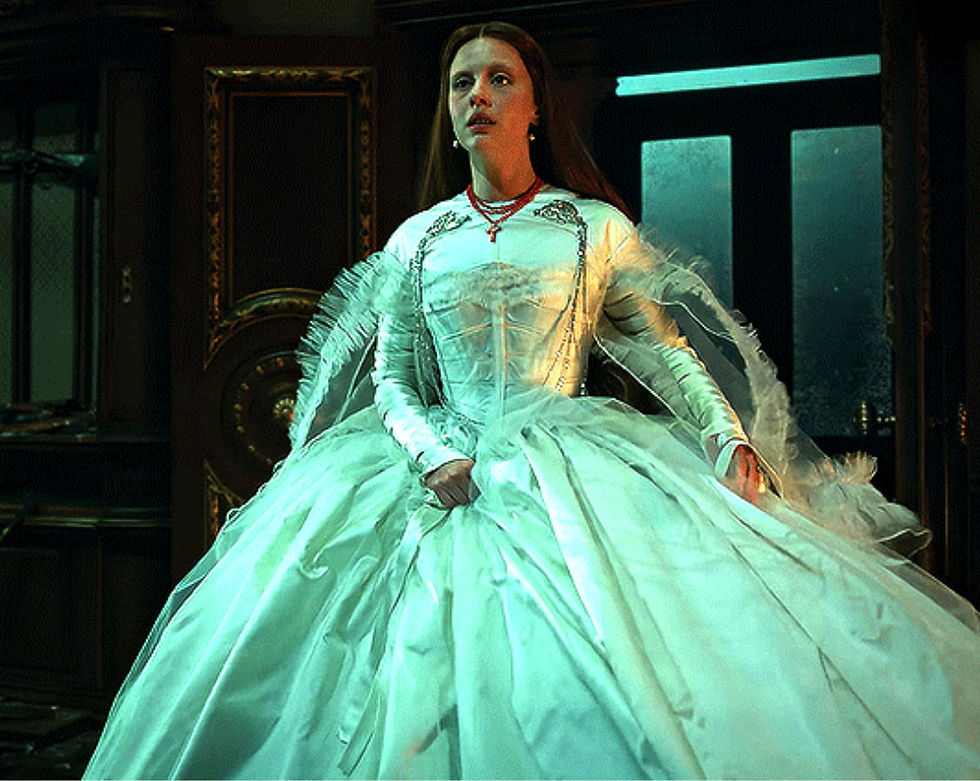
Seeing a pattern? Yes, the best part of the film to me, aside from the incredible setting design, lighting, colour, and imagery– everything about the look– was the costume design. Oh, the costumes. Oh, Mia Goth in dresses equal parts ridiculous and incredible; vibrant green with beetles crawling over her hands; blue, the hue of an ocean in tempest; moth white, the perfect shade for a smattering of death-blood. If there is anything I adore about del Toro’s directing, it is his ability to take the goth aesthetic and make a wild sprint for it.
The New Message: The Cycle of Abuse, Empathy and Womanhood
Given the ways in which it differs from the original 1818 text, I believe that Frankenstein focuses most intensely on two key thematic elements: the cycle of abuse and female empathy as a way to break that cycle. In the original novel, the elder Dr. Frankenstein is a markedly benevolent figure, both as a father to our protagonist and as a husband to Victor’s late mother. In the film, however, Victor’s father is not only seemingly responsible for the death of Victor’s mother, but also a cruel and unforgiving parent who inspires Victor’s own “parenthood” of the Creature. We see Victor’s father pressuring Victor to be a scientist, before abandoning him following his mother’s death, and especially when his younger half-brother William is born. In the book, Victor’s transgression against the Creature is simply his leaving it to the harshness of the world. The film’s unique portrayal of Victor’s father, however, justifies the decision to make Victor a cruel and almost abusive parent to the Monster, ending in him attempting to murder it, discarding it in the same way elder Dr. Frankenstein discarded his first wife and son. It is clear that Guillermo del Toro’s creative liberties are deliberate attempts to make a point about cycles of abuse, which is not made in Mary Shelley’s original work.
This becomes even more apparent with the introduction of film Elizabeth, a completely different character than her novel counterpart. In the novel, Elizabeth is Victor’s adoptive sister … and betrothed. She rests in the background as the angel promised to our protagonist, the image of perfection welcoming Victor home, only to be murdered at the end of the novel by the Creature – and this is her first encounter with the entity. In the film, not only is Elizabeth betrothed to Victor’s brother William (who, in the novel, is a child), but she also encounters the Creature just after its creation. She immediately connects with him and shows him the empathy and kindness that Victor never did. She is headstrong and cutting, condemning Victor for his treatment of his “son” and refusing his advances towards her. In the end, Elizabeth dies in the Creature’s arms, but not before the film demonstrates the true power of female empathy – of kindness coming from a person who, as a woman, knows what it is to be judged solely by their appearance, and who turns their kindness into their strength. From her first encounter with the creature, the heroine treats Victor’s creation with the kindness deserved by a being just ushered into life; this empathy is embodied in the hilarious and touching line where she accepts a leaf as a token of the monster’s affection.
To be honest, I don’t know if I enjoyed Guillermo del Toro’s rendition of Elizabeth at first, there is something to be said about the “girlboss-”ification of softer female characters in adaptational fiction – but the way in which her character came to represent female struggle and strength-- the fortitude in our softness-- has really grown on me in post. So, yeah. Slay girl.
All in all, Guillermo del Toro’s Frankenstein has definitely become one of those films that I pretentiously critique at the moment, and come to enjoy after a good long think (slash Coterie blog post). In the original novel, Elizabeth’s kindness serves as a steady backdrop to the havoc Victor’s creation wreaks on his life, and when the Creature kills her, she becomes a representative flame extinguished by the actions of a reckless Prometheus. The way in which Guillermo del Toro has reinterpreted, or rather, centralized, what Elizabeth’s kindness represents at large, may perhaps do more of a service to her character than I first thought – or at least reinstate Mary Shelley’s warning for what happens when a living being is left un-nurtured.




Performance enhancement results from streamlined interactions between IT consulting nyc tools, reducing bottlenecks and improving processing speed.